Hydrophobic Fumed Silica for Wind Power Epoxy Adhesives
Effect of Hydrophobic Fumed Silica on Tensile Strength and Elongation at Break of Wind Turbine Epoxy Adhesives
Wind turbine blades rely on epoxy structural adhesives for bonding critical load-bearing sections. During service, these adhesive joints are subjected to cyclic wind loads, thermal cycling, and environmental aging. The adhesive therefore requires high tensile strength together with appropriate elongation at break to maintain structural rigidity while accommodating deformation and reducing the risk of bond failure caused by stress concentration.
Fumed silica is widely used as a nano-functional filler in epoxy structural adhesive systems. Hydrophobic surface modification provides thixotropic and anti-sagging properties while allowing the silica to contribute to mechanical reinforcement through organic–inorganic interfacial interactions. Primary particle size, agglomeration state, surface treatment, and modification uniformity can all affect the resulting mechanical performance.
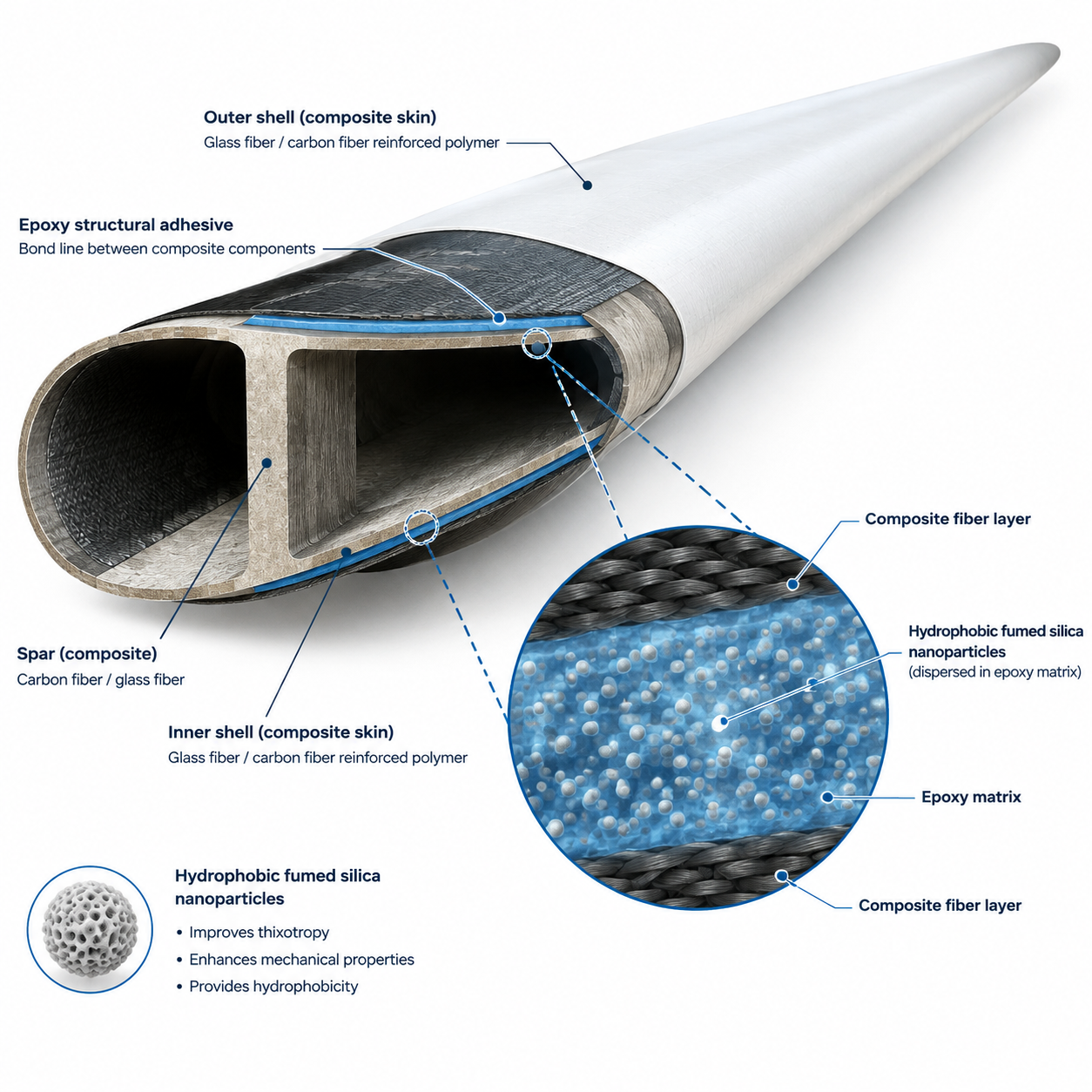
Hubei Huifu Nanomaterial Co., Ltd. evaluated hydrophobic fumed silica in an epoxy structural adhesive system for wind turbine blade applications. The study compared the tensile strength and elongation at break of a blank formulation, HIFULL® HB-139B, and four competing fumed silica products to provide practical data for filler selection in wind power adhesive formulations.
Tensile Strength and Elongation at Break

Figure 1. Effect of different hydrophobic fumed silica products on the tensile strength and elongation at break of the epoxy adhesive
As shown in Figure 1, the blank sample without fumed silica exhibited a tensile strength of approximately 50 MPa, while its elongation at break remained relatively high among the tested samples. The mechanical behavior of the epoxy adhesive changed significantly after hydrophobic fumed silica was introduced.
The sample containing HIFULL® HB-139B achieved a tensile strength of approximately 55.5 MPa, representing an increase compared with the blank matrix. The tensile strengths of the other four competing products ranged from 53 to 55 MPa, with lower overall reinforcement performance than HB-139B under the tested conditions.
Elongation at break showed an overall downward trend after the addition of fumed silica. As the nano-filler increases matrix rigidity, it also restricts the mobility of polymer chain segments in the epoxy resin, reducing the material’s deformation capacity before tensile fracture.
Considering both datasets, HB-139B provided higher tensile strength while maintaining elongation at break within a practical engineering range. The results indicate a favorable balance between strength and toughness compared with the competing products tested.
Related Reading: Why Does HIFULL® HB-139B Overshadow Both Hydrophilic and Hydrophobic Fumed Silica in Epoxy Wind Power Adhesive?
How Fumed Silica Reinforces the Epoxy Adhesive Matrix
The observed mechanical behavior can be associated with the dispersion of nano-silica particles within the epoxy matrix and their interaction with the surrounding polymer. Under an external tensile load, stress can be transferred from the resin matrix to rigid silica particles through the organic–inorganic interface. Effective stress transfer can increase the stress required for tensile failure, contributing to the observed increase in tensile strength.
At the same time, rigid nanoparticles restrict the sliding and stretching of polymer chain segments under load. The resulting reduction in polymer-chain mobility limits deformation before fracture and can therefore reduce elongation at break.
Performance differences among commercial hydrophobic fumed silica products can be associated with parameters such as primary particle size distribution, hydrophobic surface coverage, modification uniformity, and dispersion state within the epoxy system. The mechanical performance observed with HB-139B is consistent with effective filler dispersion and controlled particle–matrix interactions, allowing reinforcement while limiting the loss of deformation capacity.
HIFULL hydrophobic fumed silica, produced by chemically post-treating hydrophilic grades with silane agents (including HMDS, PDMS, DDS, and Special Silane), delivers water repellency, enhanced rheology control, and thickening performance. Available in multiple grades, it is ideally suited for RTV and HTV silicone rubber systems, adhesives & sealants, defoamers, cable compounds & gels, toner, and plant protection formulations.
Selecting Hydrophobic Fumed Silica for Wind Turbine Blade Adhesives
As wind turbine blades increase in size and length, epoxy structural adhesive formulations face tighter requirements for filler stability and mechanical-property balance. Fumed silica selection therefore needs to account for more than rheological control alone. Dispersion behavior, surface modification, tensile reinforcement, and the resulting effect on elongation at break are relevant parameters when evaluating a filler for wind turbine blade bonding applications.
Under the tested conditions, HIFULL® HB-139B produced a tensile strength of approximately 55.5 MPa, compared with approximately 50 MPa for the blank sample and 53–55 MPa for the four competing products. Combined with its maintained elongation at break, these results support the evaluation of HB-139B as a hydrophobic fumed silica for epoxy structural adhesives used in large wind turbine blade bonding applications.
Further Reading:
ABOUT HIFULL
Our main products are fumed silica, nano titanium dioxide, and nano aluminium oxide. We get 20+ years of expertise and 40,000 tons of annual capacity. We supply total of 23 grades of hydrophilic & hydrophobic fumed silica. We have registrations for EU-REACH, Turkey-REACH, K-REACH and UK-REACH. We are the leading setting body for ISO18473-3:2018, ISO23157:2021 and ISO18473-4:2022. Learn More About Hifull
Hello, Customers
My name is Van, I’m the business manager of HIFULL, I have been in Fumed Silica Industry for more than 10 years. Feel free to contact me. I’m happy to provide you the best service and products.