From Brake Pedal Failures to Fundamental Safety: How Fumed Nanomaterials Fortify Automotive Defense
Recent incidents involving fractured brake pedals have put the spotlight on the material safety and reliability design of non-metallic automotive structural components. The core failure occurred in a PP+GF40 glass fiber-reinforced polypropylene brake pedal bracket. As a critical load-bearing part of the braking system, its brittle fracture under stress exposes common industry pain points of traditional modified plastics: stress concentration, insufficient toughness, poor fatigue resistance, and internal microscopic defects that are difficult to eliminate.
New energy vehicles raise the bar further: lightweighting, high loads and high-frequency operating conditions push conventional glass fiber-modified plastics and standard friction materials past their limits. Three fumed nanomaterials — fumed silica, nano alumina and nano titania — tackle these weaknesses at the microscopic level.
Unlike conventional powders, fumed materials feature uniform particle size, high purity, excellent dispersion, and strong surface activity. HIFULL fumed silica, for example, delivers BET specific surface areas of 30–450 m²/g with SiO₂ purity above 99.8% — at low addition levels, these powders upgrade the microstructure of composites across five dimensions: strength, toughness, heat resistance, wear resistance and stability.

Fumed Silica: Healing Micro-Defects in Load-Bearing Parts
Fumed silica is the core nano-reinforcing and interfacial modifying filler for automotive polymer composites. With a primary particle size of just a few dozen nanometers and abundant active silanol groups on its surface, it forms stable hydrogen bonds and chemical interfaces with polymer matrices such as polypropylene and phenolic resins.
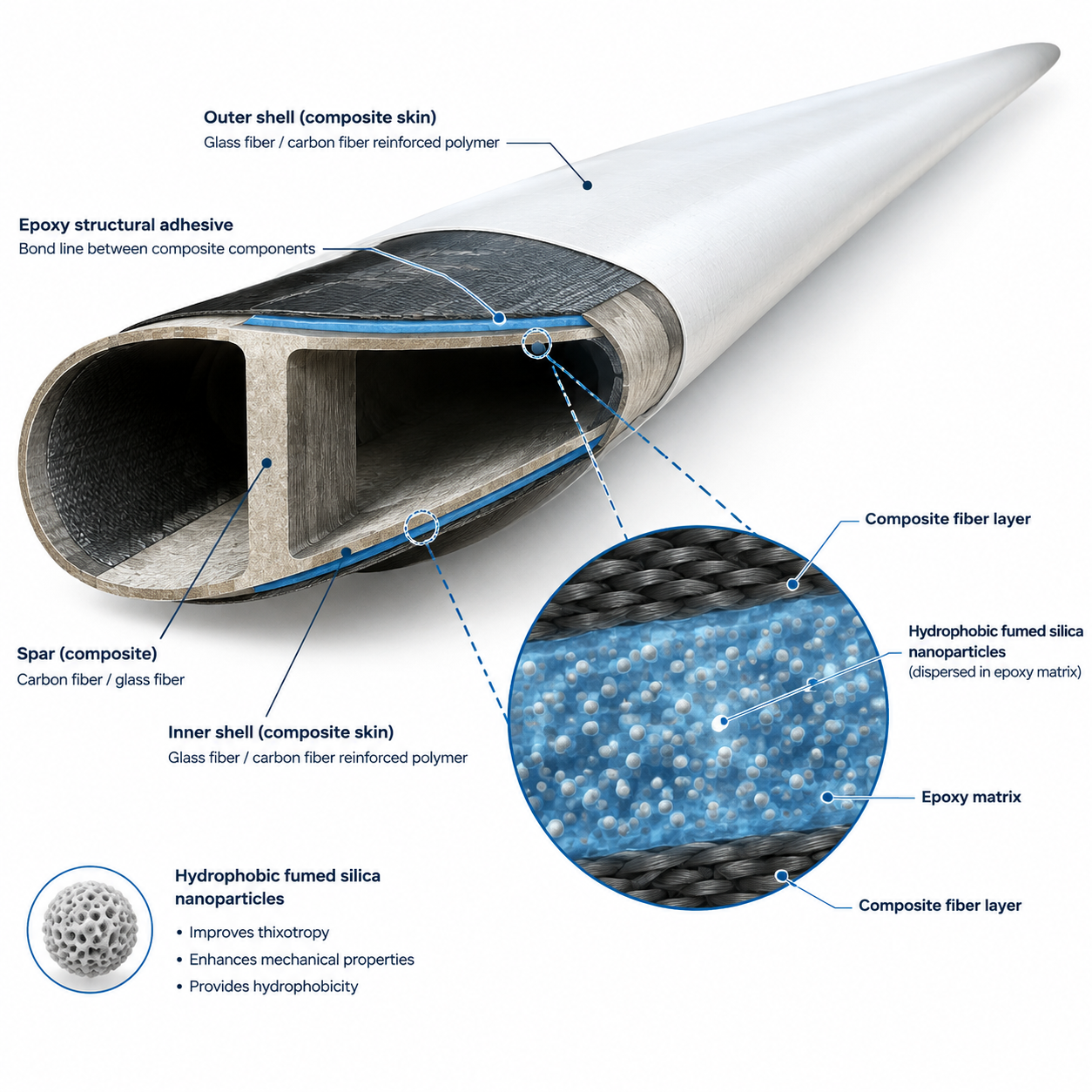
For load-bearing structures such as brake pedals, brackets, and underbody shields, HIFULL® hydrophobic fumed silica (HB series) fills internal micro-voids and micro-cracks within glass fiber-modified plastics. It pins polymer chains, effectively hindering crack propagation under stress. This significantly boosts impact strength, fracture toughness, and fatigue resistance, mitigating the brittleness of the PP+GF system and reducing stress concentration at weld lines.
Its thixotropic properties also improve molding flow, ensuring more uniform dispersion of components, consistent part quality, and lower batch-to-batch safety risks.
For brake pad friction materials, the same filler helps build a stable friction-interface transfer film, suppressing the decay of the friction coefficient under high-intensity braking. This alleviates thermal fade, keeps braking force stable during continuous or high-temperature braking, and helps prevent dangerous conditions such as brake judder.
Nano Alumina: The Barrier for Structural and Thermal Safety
Nano alumina is a functional nanomaterial known for its high hardness, high-temperature resistance, electrical insulation, and wear resistance. It improves the structural stability and operational safety of core automotive components — above all, battery safety in new energy vehicles.
In power battery systems, HIFULL® nano alumina (AluNa series) is mainly used in ceramic coatings for lithium battery separators, battery insulation sheets, and electronic control insulation substrates. Conventional separators can melt or shrink under high temperature, compression, or collision, leading to cell short circuits, thermal runaway, and even fire or explosion. Separators modified with nano alumina show significantly improved heat resistance, helping prevent deformation and rupture, and reducing the risk of internal short circuits.
The material also combines thermal conductivity with electrical insulation, helping balance battery temperature, eliminate local hot spots, and prevent leakage or dielectric breakdown under extreme operating conditions.
Nano Titania: Visibility, Durability, and Cabin Health
Where alumina focuses on structural and thermal protection, nano titania brings strong UV shielding, photo-induced superhydrophilic anti-fogging, and photocatalytic purification — supporting driving visibility, component durability, and cabin health.
Its strong UV blocking capability can be incorporated into automotive paint, exterior trims, and interior coatings, helping protect against ultraviolet erosion. This delays paint aging and cracking, interior plastic embrittlement, and rubber seal degradation, reducing safety risks caused by sealing failure or component deterioration, and extending the service life of vehicle parts.
For driving safety, the photo-induced superhydrophilic property of nano titania helps address fogging on windshields, rearview mirrors, and headlights. The coating allows water vapor to spread evenly across the surface instead of forming droplets, reducing visual blind spots in rainy or high temperature-difference conditions. Its photocatalytic self-cleaning function can also decompose oil stains and insect residues, helping keep headlights and glass clean, maintaining light transmittance and driving visibility.
For cabin health, nano titania can continuously degrade harmful gases such as formaldehyde and TVOCs through photocatalytic reactions, adsorb and break down odors, and inhibit bacterial growth — purifying cabin air and reducing the impact of harmful gases on occupants.
One Composite, Multiple Layers of Protection
These three fumed nanomaterials do not work in isolation. Through compounding and synergy, they form a comprehensive safety system characterized by high strength and toughness, heat resistance, stability, and long service life.
Unlike marginal gains from structural optimization or process iteration, nanomaterials reshape performance at the molecular and interfacial levels — addressing brittle fracture, aging, thermal failure, and excessive wear at their source.
HIFULL® supplies fumed silica, nano alumina and nano titania in automotive-grade batches, with TDS, samples and application testing support available for compounders and Tier-1 suppliers working on braking, battery and visibility components.
Further Reading:
ABOUT HIFULL
Our main products are fumed silica, nano titanium dioxide, and nano aluminium oxide. We get 20+ years of expertise and 40,000 tons of annual capacity. We supply total of 23 grades of hydrophilic & hydrophobic fumed silica. We have registrations for EU-REACH, Turkey-REACH, K-REACH and UK-REACH. We are the leading setting body for ISO18473-3:2018, ISO23157:2021 and ISO18473-4:2022. Learn More About Hifull
Hello, Customers
My name is Van, I’m the business manager of HIFULL, I have been in Fumed Silica Industry for more than 10 years. Feel free to contact me. I’m happy to provide you the best service and products.