Fumed Silica Optimization for Sag Resistance in Epoxy Wind Blade Adhesives
Impact of Hydrophobic Fumed Silica Loading on the Sag Resistance of Epoxy Structural Adhesives for Wind Energy
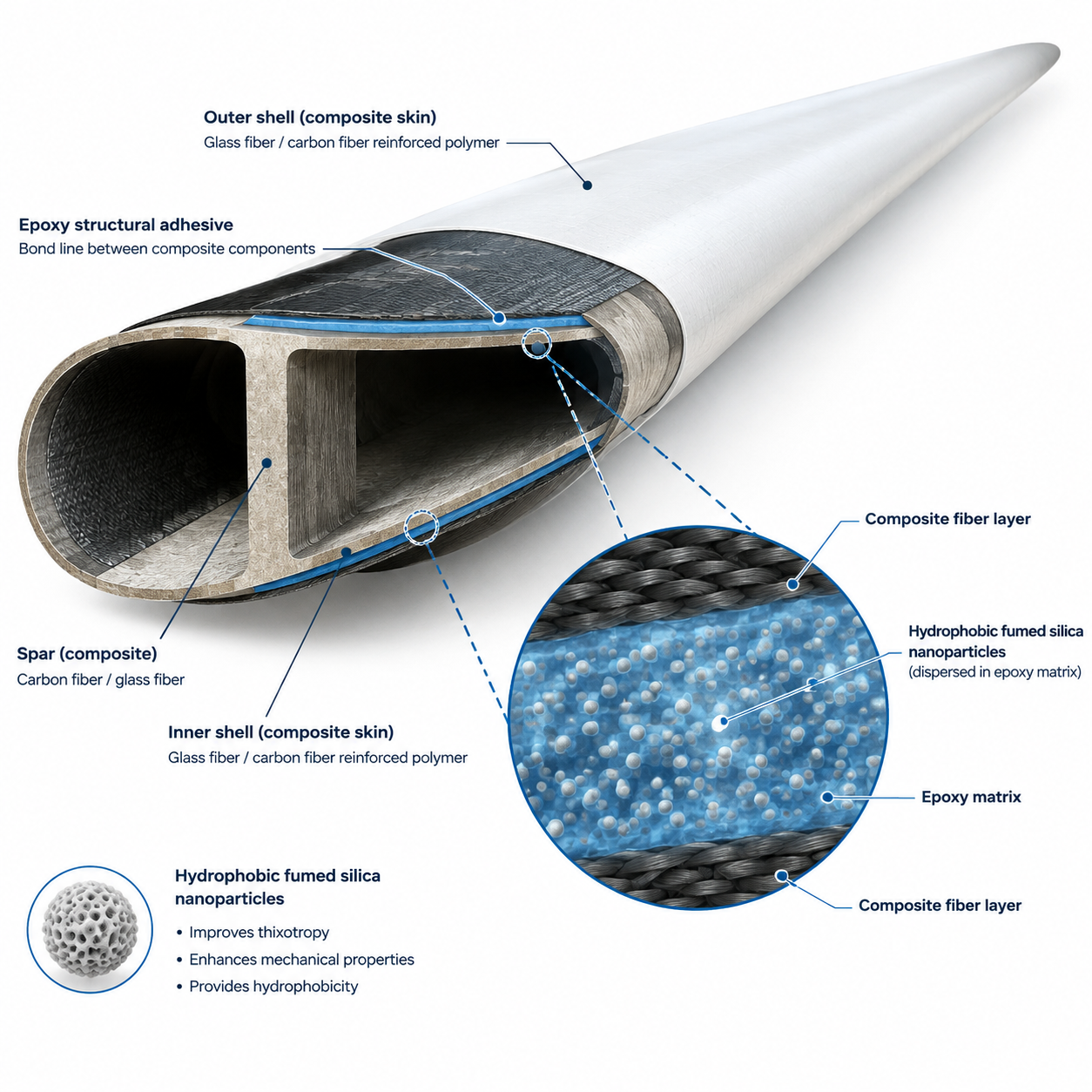
Epoxy structural adhesives are critical for bonding wind turbine blade components, towers, and hubs, owing to their high mechanical strength, weather resistance, and chemical stability.
However, in factory applications, these adhesives frequently sag on vertical or inclined substrates. This gravitational flow and deformation before curing leads to uneven bond-line thickness, interfacial defects, and structural debonding risks, directly compromising the long-term operational lifespan of wind power systems.

Hydrophobic fumed silica variants undergo surface modification with organosilane coupling agents, lowering interfacial tension and enhancing compatibility with organic polymer matrices. This treatment optimizes thixotropy, anti-sagging performance, and mechanical properties in adhesive formulations. To quantify these effects, HIFULL evaluated the influence of hydrophobic fumed silica loading levels on the sagging parameters of a standard epoxy wind power adhesive matrix.
Fumed silica is a nano-scale inorganic material synthesized via high-temperature gas-phase hydrolysis. It is characterized by a primary particle size of 7–40 nm, a specific surface area of 30–450 m²/g, high chemical purity, and high surface activity. Hubei Huifu Nanomaterial Co., Ltd. (HIFULL) develops and manufactures both hydrophilic and hydrophobic fumed silica series, providing localized, quality-controlled material optimization and technical customization for new energy, electronics, and aerospace manufacturing chains.

Figure 1
As demonstrated in Figure 1, increasing the concentration of hydrophobic fumed silica systematically reduces adhesive sag. The blank control sample exhibits low baseline viscosity, resulting in severe gravitational flow and material accumulation.
At a 6% loading level, the adhesive retains significant fluidity, displaying clear gravitational sagging and distinct dripping at the base of the specimen.
When the loading level is increased to 8% and 10%, the adhesive maintains its initial applied geometry with negligible deformation, establishing excellent anti-sagging properties.
These results confirm that targeted fumed silica addition enhances the thixotropic index and thickening efficiency of the epoxy matrix.
Network Structure and Thixotropic Mechanism
The underlying physical mechanism depends on the formation of a three-dimensional network structure within the epoxy matrix. At lower concentrations (e.g., 6%), the nanoparticles are insufficient to form a continuous skeleton, thereby only partially restricting the mobility of the resin molecules. When the loading reaches 8% or higher, the nano-scale silica particles interact via van der Waals forces and hydrogen bonding to form an interconnected spatial network.
This network imparts high viscosity under static, low-shear conditions, preventing gravitational slump. Under external shear forces (such as mixing or application), these secondary bonds temporarily disrupt, reducing viscosity to facilitate processing and substrate wetting. Upon cessation of shear, the network rapidly recovers, restoring sag resistance. Concurrently, the hydrophobic surface modification repels moisture, improving dispersion uniformity and long-term rheological stability within the resin.
Formulation Optimization for Production Lines
While a 10% loading level provides the highest sag resistance, excessive filler content can elevate formulation costs and potentially reduce cured toughness or increase application viscosity beyond processing limits. Practical production requires balancing rheological specifications against process economics.
Experimental data indicates that a hydrophobic fumed silica loading of 8% to 10% optimizes the balance between rheological behavior and practical constructability. This range ensures uniform bond-line geometry during high-altitude component assembly and wind turbine manufacturing, providing predictable performance parameters for industrial formulation design.
Further Reading:
Hello, Customers
My name is Van, I’m the business manager of HIFULL, I have been in Fumed Silica Industry for more than 10 years. Feel free to contact me. I’m happy to provide you the best service and products.