Anti-Sag Performance of Hydrophobic Fumed Silica in Wind Power Structural Adhesives
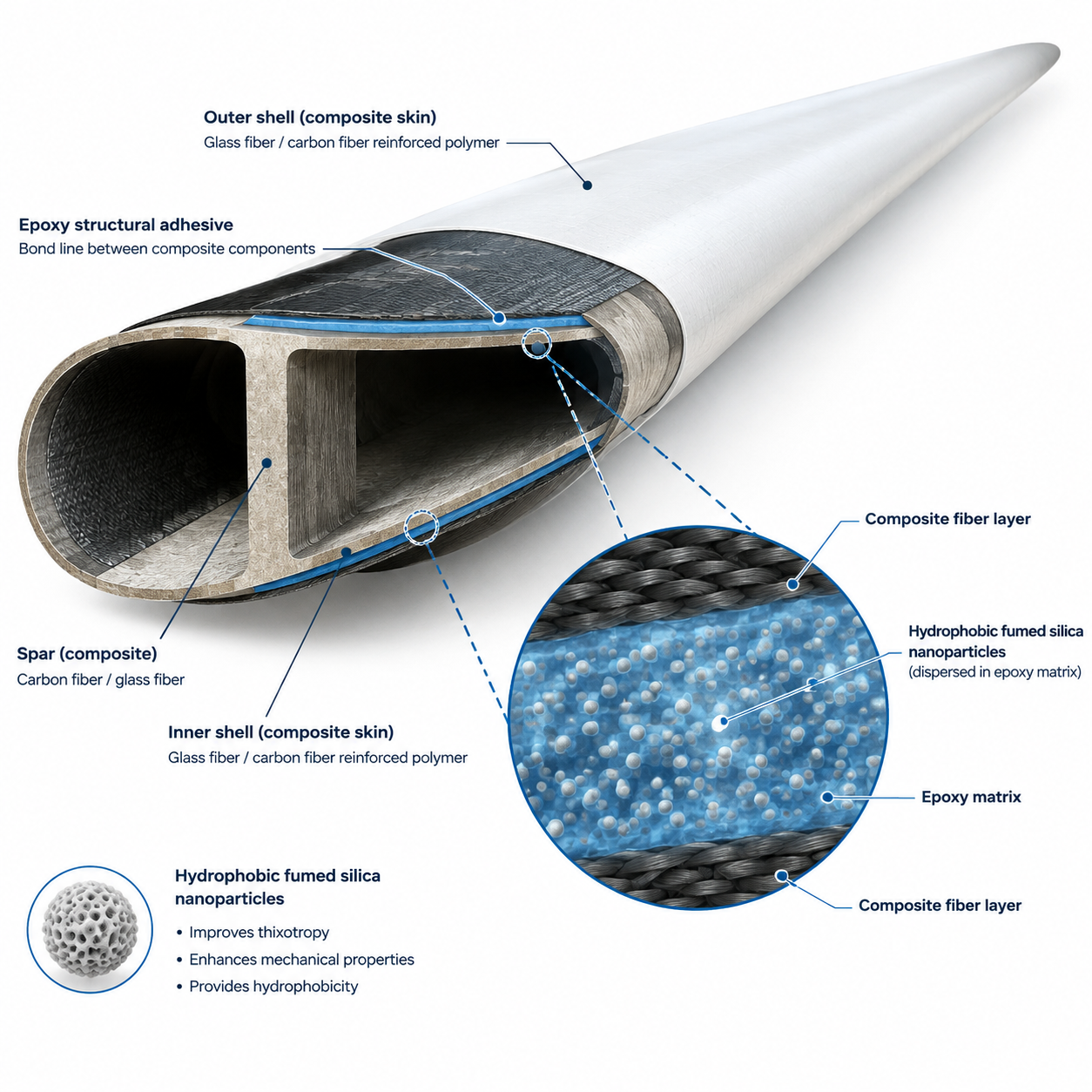
Wind power structural adhesives face a recurring problem during blade and tower assembly: when applied to vertical surfaces, the adhesive tends to flow or sag before curing.
Sagging produces an uneven bond line, weakens interfacial bonding strength, and directly compromises the reliability, safety, and construction efficiency of wind power components.
Fumed silica addresses this through its nano-network structure, which gives the adhesive thixotropy and sag resistance, and it has become a standard rheological additive in wind power adhesive formulations.

To support raw material selection, HIFULL technicians tested the anti-sag performance of hydrophobic fumed silica HB-139B against a blank formulation and four competitor products in the same wind power adhesive system.
Evaluation Setup

Figure 1. Anti-sag test of the blank, HB-139B, and four competitor products in a wind power adhesive system.
As shown in Figure 1, the test groups comprised a blank, HB-139B, and four competitor products. We applied each adhesive to a standard substrate and left it to stand under specified conditions, then measured the sag distance under gravity. A sag reference sample was included to illustrate a non-conforming flow state.
The blank sample showed poor anti-sag performance: the adhesive failed to hold its initial shape and flowed severely under gravity.
The HB-139B sample and all four competitor samples performed significantly better. All five adhesives held their initial application shape, with sag distances below 2 mm. HB-139B and the competitor products effectively resolved the slumping problem in wind power adhesives, delivering stable rheological performance that meets industrial application requirements.
Related Reading: Why Does HIFULL® HB-139B Overshadow Both Hydrophilic and Hydrophobic Fumed Silica in Epoxy Wind Power Adhesive?
Anti-Sag Mechanism of HB-139B
HB-139B hydrophobic fumed silica is surface-modified with silane coupling agents. When dispersed in polar organic media such as epoxy resins, this modification shields part of the polar silanol groups, while a small number of active sites remain available.
The particles link together through residual hydrogen bonding and van der Waals forces, forming a reversible three-dimensional network throughout the system. This network holds the adhesive in place during vertical application and ensures a uniform, structurally sound adhesive layer at the bond line of wind turbine blades.
Batch Consistency for Field Application
Larger turbine capacities and longer blades expose adhesives to harsher conditions: wider temperature ranges, greater application thicknesses, and outdoor on-site construction. These conditions raise the bar for the rheological stability and batch consistency of additives.
HIFULL® HB-139B hydrophobic fumed silica, produced with controllable nano-powder surface modification technology, provides consistent rheological control for high-end composite systems such as structural adhesives and anticorrosion coatings. In practice, this translates into repeatable sag control across production batches — from blade bonding to tower section assembly — even under outdoor construction conditions.
HIFULL hydrophobic fumed silica, produced by chemically post-treating hydrophilic grades with silane agents (including HMDS, PDMS, DDS, and Special Silane), delivers water repellency, enhanced rheology control, and thickening performance. Available in multiple grades, it is ideally suited for RTV and HTV silicone rubber systems, adhesives & sealants, defoamers, cable compounds & gels, toner, and plant protection formulations.
Further Reading:
ABOUT HIFULL
Our main products are fumed silica, nano titanium dioxide, and nano aluminium oxide. We get 20+ years of expertise and 40,000 tons of annual capacity. We supply total of 23 grades of hydrophilic & hydrophobic fumed silica. We have registrations for EU-REACH, Turkey-REACH, K-REACH and UK-REACH. We are the leading setting body for ISO18473-3:2018, ISO23157:2021 and ISO18473-4:2022. Learn More About Hifull
Hello, Customers
My name is Van, I’m the business manager of HIFULL, I have been in Fumed Silica Industry for more than 10 years. Feel free to contact me. I’m happy to provide you the best service and products.