Mechanical Requirements for Power Battery Structural Adhesives
Power battery adhesives serve as critical bonding media connecting cells to modules and modules to battery housings. During electric vehicle (EV) operation, these bonded joints are subjected to dynamic loading, impact, continuous vibration, and extreme temperature cycling.
To maintain structural integrity and safety margins over long service lifespans, adhesives are evaluated using two core mechanical parameters:
- Tensile Strength: Measures the adhesive layer’s resistance to structural failure under axial tensile loading.
- Shear Strength: Evaluates resistance to joint displacement and relative slippage under shear loads.

Reinforcement & Thixotropic Mechanism of Fumed Silica
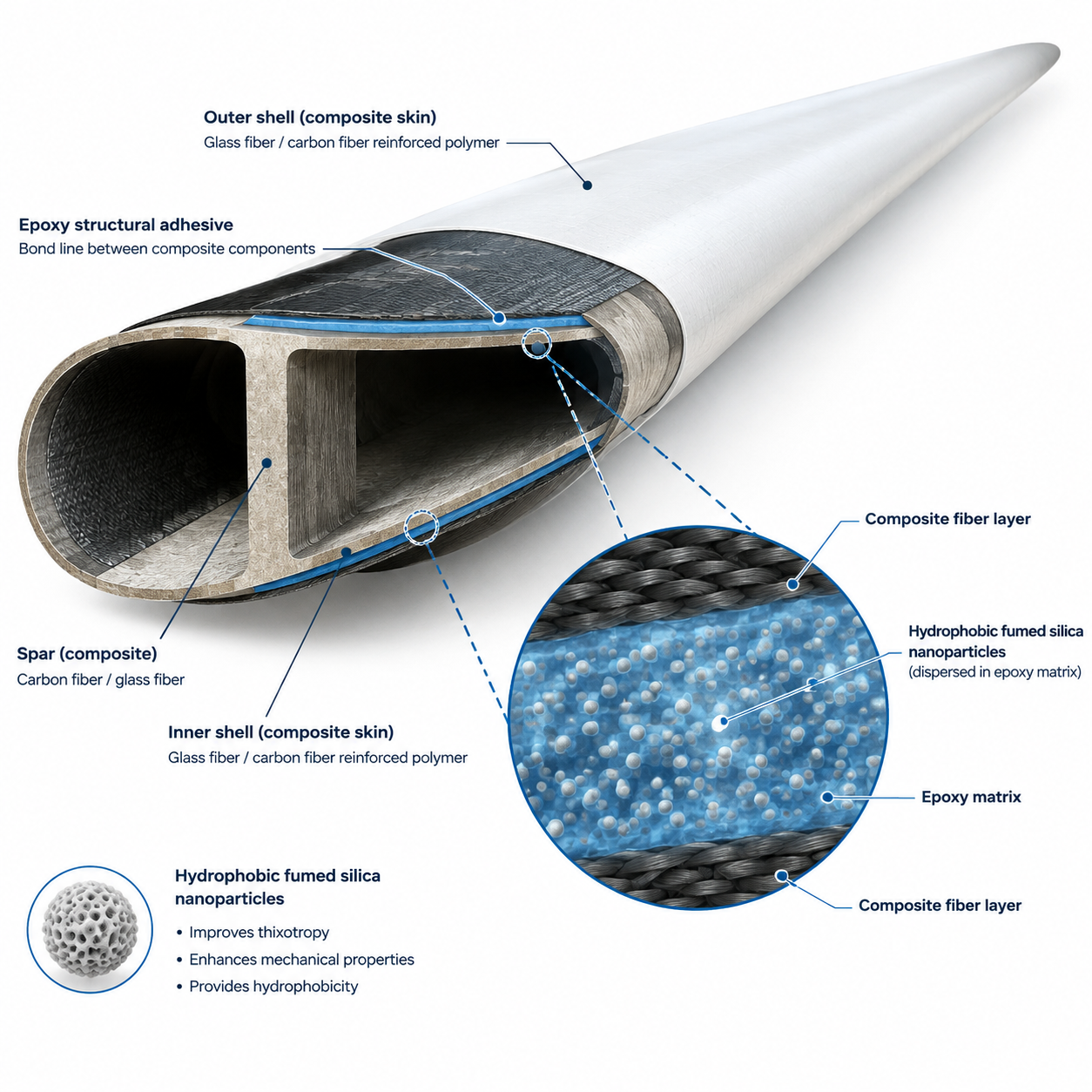
Fumed silica is a nanoscale inorganic powder with an abundance of surface silanol groups. In power battery adhesive systems, these functional surface groups form hydrogen bonds with polymer resin molecules, creating a three-dimensional physical network.
Reinforcement & Rheology Mechanism
Fumed silica features an abundance of surface silanol groups that form hydrogen bonds with polymer resin chains. This interaction creates a robust three-dimensional physical network, providing dual benefits in structural performance and application behavior:
| Mechanism Stage | Functional Interaction | Key Performance Benefits |
|---|---|---|
| Physical Cross-Linking | Surface silanol groups form a dense hydrogen-bonded 3D network with the resin matrix. | • Stress Distribution: Evenly distributes axial tensile stress. • Cohesive Strength: Enhances structural rigidity & load resistance. |
| Rheological Control | Network structure increases structural viscosity under low shear conditions. | • Anti-Sagging: Prevents slumping after high-speed dispensing. • Anti-Stringing: Clean break-off at automated dispensing nozzles. |
Surface Modification & Dispersion Quality
To fully utilize the nanoscale reinforcement effect without causing filler agglomeration, Hubei Huifu Nanomaterial Co., Ltd. employs specialized surface-modification processes on HIFULL fumed silica. This enables uniform dispersion throughout the resin matrix, providing dual enhancement in mechanical reliability and application processability.

Adhesives & Sealants
Experimental Data: Tensile & Shear Strength Evaluation
HIFULL technical personnel evaluated the mechanical performance of power battery adhesives formulated with varying addition levels of fumed silica (0%, 3%, and 5%).

Performance Comparison Table
| Fumed Silica Dosage (wt%) | Tensile Strength (MPa) | Shear Strength (MPa) | Microstructural & Matrix Behavior |
|---|---|---|---|
| 0% (Baseline Control) | 9.3 | 5.8 | Low cohesion, lower resistance to shear displacement and mechanical deformation. |
| 3% (Optimal Ratio) | 15.6 (+68%) | Peak Value | Optimal Network: Uniform particle dispersion; high hydrogen bond density; efficient axial stress distribution. |
| 5% (Excessive Loading) | 14.8 | Declined | Particle Agglomeration: Strong inter-particle bonding forms micron-sized clumps, creating stress concentration points. |
Detailed Results Analysis
1. Effect of Fumed Silica on Tensile Strength
- 0% to 3% Loading: Tensile strength shows a continuous upward trend, rising from 9.3 MPa to 15.6 MPa (an improvement of approximately 68%). The well-dispersed HIFULL fumed silica particles build a dense physical cross-linking network that delays localized tensile failure.
- 3% to 5% Loading: Further increasing the dosage to 5% leads to a slight decline in tensile strength to 14.8 MPa. Strong hydrogen interactions at high concentrations force particles to cluster into micron-sized agglomerates, disrupting matrix uniformity and acting as internal stress concentration sites.
2. Effect of Fumed Silica on Shear Strength
- Shear strength follows a clear pattern of an initial rapid increase followed by a decline.
- Starting from a baseline of 5.8 MPa at 0%, shear strength surges rapidly with increasing silica content, peaking at 3% silica.
- Beyond 3%, excessive filler concentration triggers agglomeration, lowering overall dispersion quality and reducing shear load resistance.
Further Reading:
Conclusion & Formulation Guidelines
Based on combined mechanical testing, 3% fumed silica is the optimal addition level for power battery structural adhesives.
At this ratio, the nanoscale filler and polymer matrix establish a uniform, stable three-dimensional network. Formulations achieve maximum tensile (15.6 MPa) and shear strength performance without suffering from high-dosage powder agglomeration.
Maintaining precise loading control around 3% provides adhesive manufacturers with a technical reference for optimizing cell bonding, module assembly, housing fixation, and automated dispensing processes in new energy vehicle applications.
ABOUT HIFULL
Our main products are fumed silica, nano titanium dioxide, and nano aluminium oxide. We get 20+ years of expertise and 40,000 tons of annual capacity. We supply total of 23 grades of hydrophilic & hydrophobic fumed silica. We have registrations for EU-REACH, Turkey-REACH, K-REACH and UK-REACH. We are the leading setting body for ISO18473-3:2018, ISO23157:2021 and ISO18473-4:2022. Learn More About Hifull
Hello, Customers
My name is Van, I’m the business manager of HIFULL, I have been in Fumed Silica Industry for more than 10 years. Feel free to contact me. I’m happy to provide you the best service and products.