The Thermal Insulation Mechanism and Effect of Fumed Silica in Insulating Coatings
Thermal conductivity is the definitive metric for evaluating the performance of industrial and architectural insulating coatings. Lowering this value directly correlates with enhanced thermal insulation efficiency. Fumed silica, characterized by its unique nanostructure, functions as a high-efficiency additive to optimize the thermal barrier performance of coating matrices.
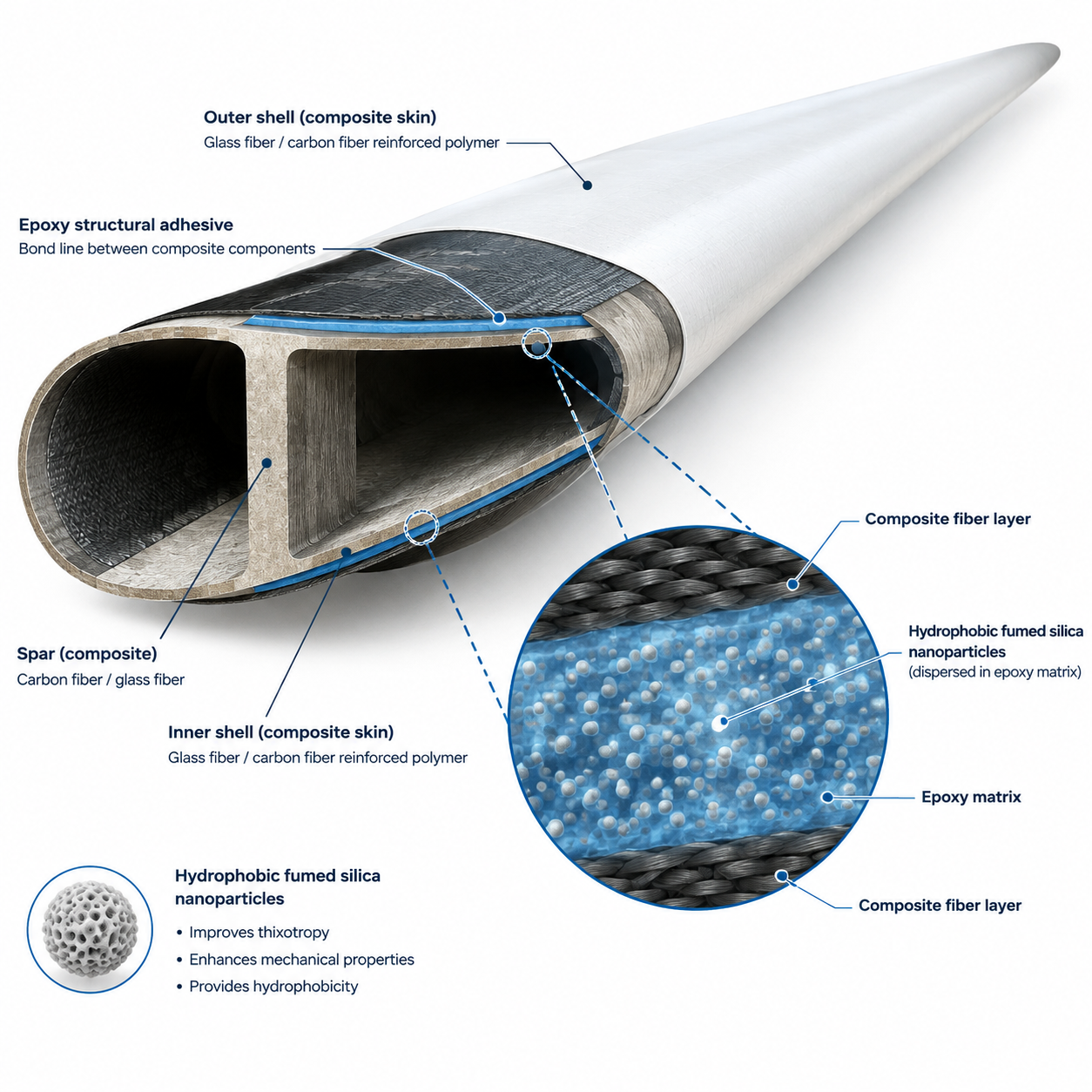
Fumed silica is an amorphous nanoscale powder generated through the high-temperature hydrolysis of silicon halides. It features a high specific surface area, high purity, and excellent dispersibility. Hubei Huifu Nanomaterial Co., Ltd. utilizes independently developed production processes and rigorous quality control protocols to manufacture fumed silica with controlled particle sizes and structural stability. The material serves as a core functional nano-filler across coatings, rubber, and adhesives.
To investigate the specific impact of fumed silica on thermal performance, the HIFULL technical team evaluated the correlation between filler loading and insulation efficiency. The thermal conductivity of a blank control sample was compared against an insulating coating formulated with 10% fumed silica.
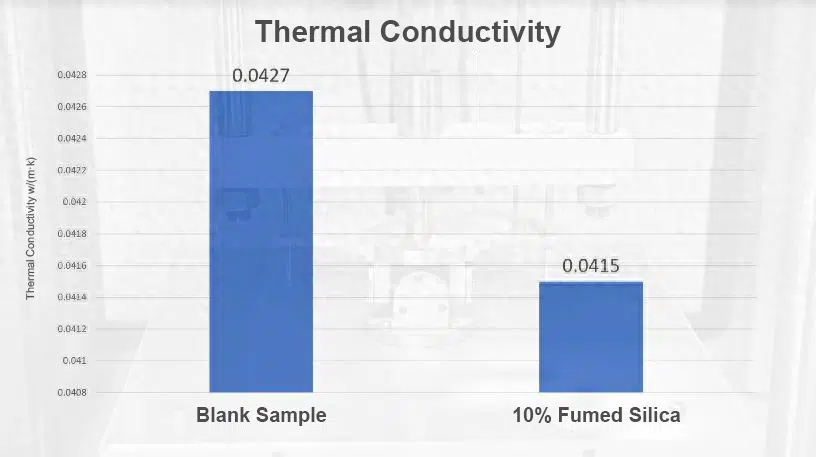
The experimental data indicates that the control coating exhibited a thermal conductivity of 0.0427 W/(m·K). Upon the addition of 10% fumed silica, the thermal conductivity dropped to 0.0415 W/(m·K), representing a reduction of approximately 2.81%. This confirms that fumed silica incorporation effectively restricts heat transfer within the coating film.
1. Nanoporous Structure and Conduction Path Disruption
Fumed silica aggregates into a three-dimensional branched network structure. Its nanoscale primary particle size and high specific surface area generate a dense population of micro- and nano-sized air pores within the dried coating film. Because stagnant air is a poor conductor of heat, these microscopic air pockets disrupt the continuity of solid heat conduction paths, lowering overall thermal conductivity.
2. Interfacial Thermal Resistance and Scattering
The introduction of fumed silica creates a massive volume of phase boundaries between the nano-filler and the polymer matrix. These extensive interfaces act as physical barriers to heat flow, inducing intense scattering effects that significantly increase interfacial thermal resistance and impede heat transfer at the nanoscale.
3. Infrared Radiation Blocking
The particle size of fumed silica is comparable to the wavelengths of infrared thermal radiation. This spatial configuration creates a strong scattering effect on infrared photons, blocking radiative heat transfer through the coating. This radiation-shielding mechanism becomes highly pronounced in medium- to high-temperature environments, further improving the thermal barrier properties.
In architectural applications, insulating coatings formulated with low thermal conductivity minimize energy consumption for building heating and cooling systems, supporting energy efficiency upgrades for both new and existing structures. In industrial sectors, these high-performance coatings are deployed on petrochemical equipment, thermal pipeline networks, and process vessels to mitigate heat loss and optimize production energy efficiency.
Further Reading:
Hello, Customers
My name is Van, I’m the business manager of HIFULL, I have been in Fumed Silica Industry for more than 10 years. Feel free to contact me. I’m happy to provide you the best service and products.