Exploration and Comparison of Hydrophilic and Hydrophobic Fumed Silica in UV Plastic Coatings
UV plastic coatings, as an efficient and environmentally friendly coating system, are widely used for the protection and decoration of plastic product surfaces. Fumed silica serves as a crucial additive, significantly enhancing various properties of UV plastic coatings due to its unique nanostructure and excellent characteristics, playing a key role particularly in influencing viscosity and thixotropy.
This paper aims to provide a detailed exploration of the impact of HIFULL® hydrophilic fumed silica HL-200 versus its competitor A, and HIFULL® hydrophobic fumed silica HB-151 versus its competitor B, on the viscosity and thixotropy of UV plastic coatings.


Fumed silica is an amorphous silica produced by the hydrolysis of volatile chlorosilanes in a hydrogen-oxygen flame. It consists of nanoscale primary particles, typically ranging from 7-40 nm. Its aggregate and agglomerate structures result in a highly developed specific surface area, generally between 50-450 m2/g. This unique microstructure imparts a range of special properties to fumed silica, such as high purity, high specific surface area, high reactivity, good dispersibility, and a significant ability to influence the rheological properties of the system.
Hydrophilic fumed silica retains a large number of silanol groups on its surface, making it hydrophilic, capable of being wetted by and dispersed in water. Within the UV plastic coating system, the silanol groups on the surface form a physical cross-linking network through interactions such as hydrogen bonding, affecting the coating’s viscosity and thixotropy.
Hydrophobic fumed silica is produced by surface modification of hydrophilic fumed silica, commonly using agents such as Hexamethyldisilazane (HMDS) or Dimethyldichlorosilane (DDS). After modification, the surface silanol groups are either reacted with or shielded, resulting in a hydrophobic character. In UV plastic coatings, hydrophobic fumed silica can influence the coating’s rheology not only through hydrogen bonding from the remaining silanol groups but also via the entanglement of the treatment agent molecules.
what specific effects does hydrophilic fumed silica have on the viscosity and thixotropy of UV plastic coatings?
The incorporation of hydrophilic fumed silica effectively increases the viscosity of UV plastic coatings. Hydrogen bonds form between the surface silanol groups, establishing a three-dimensional network structure that hinders the free flow of molecules within the coating, macroscopically manifesting as increased viscosity. When subjected to external forces (such as shear during brushing or spraying), this hydrogen-bonded network is partially broken down, leading to a decrease in viscosity and allowing the coating to be applied smoothly.
Once the external force is removed, the hydrogen-bonded network gradually reforms, and the viscosity recovers. This provides excellent thixotropic behavior, effectively preventing sagging during application, improving the storage stability of the coating, and helping to prevent the settling of solid particles like pigments.


Taking HIFULL® hydrophilic fumed silica HL-200 as an example, in a UV plastic coatings application, when the addition level was 0.5%, the viscosity and thixotropic index of UV plastic coating show little change. However, as the addition level increases from 0.5% to 2%, the viscosity at low shear rate increases from 400 Pa·s to 3100 Pa·s, a significant increase of 675%.
At high shear rate, the viscosity also rises from 420 Pa·s to 1100 Pa·s, an increase of 161%. These respective increases meet the flow requirements of the UV plastic coating under different application conditions. The thixotropic index increases from 0.9 to 2.8, representing an increase of approximately 210%. Meanwhile, Competitor A shows comparable thickening and thixotropic behavior to HL-200, reaching an optimal cost-performance benefit at a 1.5% dosage.


And taking HIFULL® hydrophobic fumed silica HB-151 as an example, when the addition level is 0.5%, the viscosity and thixotropic index of UV plastic coating show little change. However, as the addition level increases from 0.5% to 2%, the viscosity at low shear rate rises from 400 Pa·s to 2800 Pa·s, a significant increase of 600%. Meanwhile, the viscosity at high shear rate increases from 420 Pa·s to 1050 Pa·s, a rise of 150%. The thixotropic index also increases from 0.9 to 2.8, representing a growth of approximately 210%. Furthermore, Competitor B shows comparable thickening and thixotropic behavior to HB-151, reaching an optimal cost-performance benefit at a 1.5% dosage.
In UV plastic coatings, hydrophobic fumed silica primarily influences the coating’s rheological properties through hydrogen bonding from surface silanol groups and the entanglement of the treatment agent molecules. Due to its hydrophobic nature, it interacts more readily with non-polar organic molecules in the coating system, forming a loose network structure. Compared to the hydrophilic type, hydrophobic fumed silica provides a slightly weaker effect on increasing the coating’s viscosity.
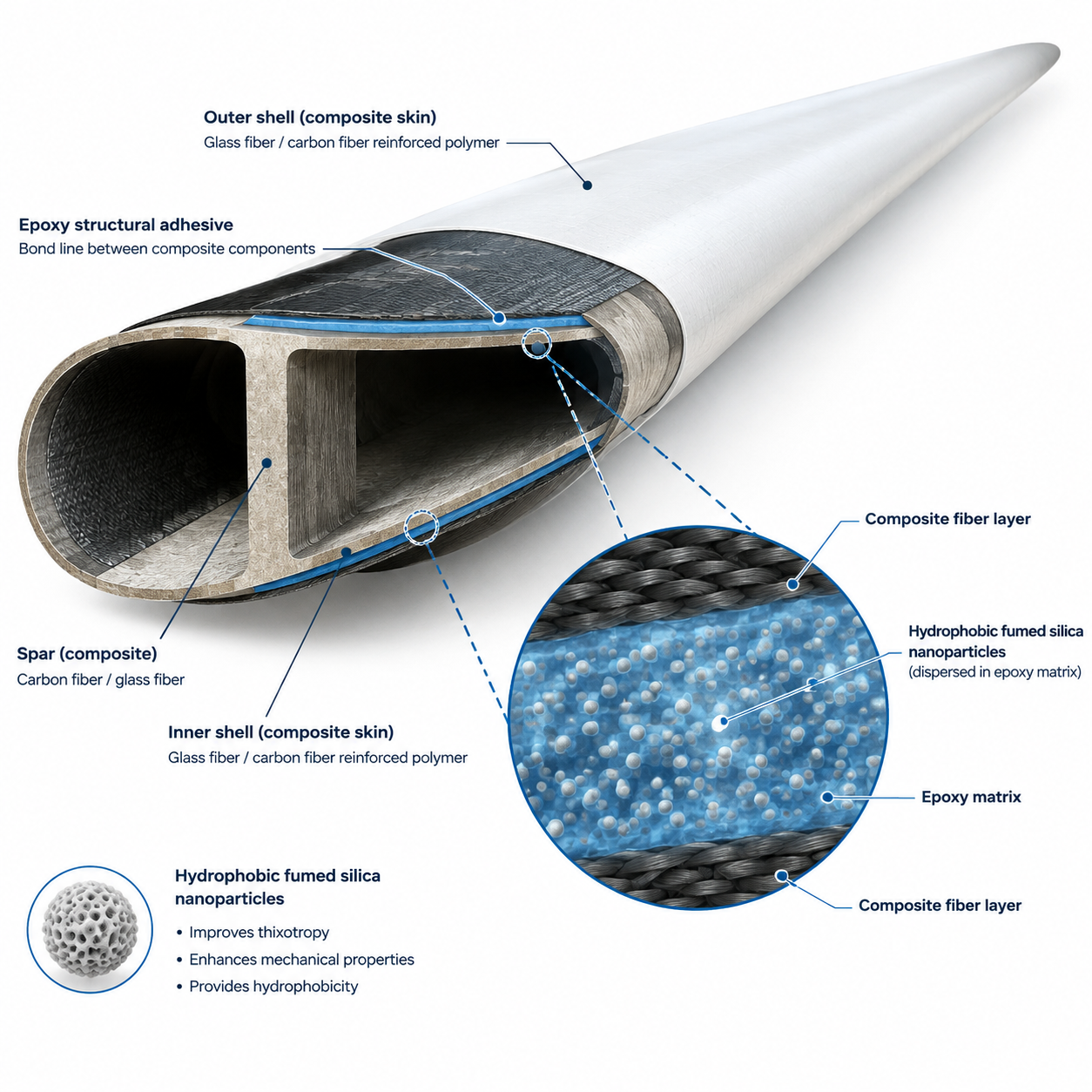
In UV plastic coating formulations where higher water resistance is required, HIFULL® hydrophobic fumed silica not only imparts good thixotropy to the coating, effectively preventing sagging, but also significantly enhances the water resistance of the cured film by reducing the adsorption and penetration of water molecules.
Both hydrophilic and hydrophobic fumed silica can significantly impact the viscosity and thixotropy in UV plastic coatings through their unique mechanisms, providing excellent application properties and storage stability. The hydrophilic type relies mainly on hydrogen bonding from surface hydroxyl groups, while the hydrophobic type functions through hydrogen bonding from surface silanols as well as the entanglement of treatment agent molecules.
In practical applications, the type and addition level of fumed silica should be rationally selected based on the specific performance requirements of the UV plastic coating. This optimization helps meet the coating demands of various plastic products and promotes the advancement of the UV plastic coatings industry.
Hello, Customers
My name is Van, I’m the business manager of HIFULL, I have been in Fumed Silica Industry for more than 10 years. Feel free to contact me. I’m happy to provide you the best service and products.