The Effect Of Fumed Silica On The Thickening And Thixotropic Properties Of Epoxy Resin Adhesives
Epoxy resin adhesives possess excellent bonding strength, good heat resistance, chemical stability, and electrical insulation properties, making them suitable for applications in electronic packaging, aerospace, automotive manufacturing, and building structures.
However, epoxy resin systems inherently suffer from poor flowability and difficult application. Especially during precision assembly or application to vertical surfaces, sagging is prone to occur, limiting their application range. The rheological properties of adhesives can be adjusted by adding functional fillers such as fumed silica.
HIFULL’s technical staff analyzed the effects of different amounts of fumed silica HB-139 added on the viscosity and thixotropic properties of epoxy resin adhesives and explored its mechanism of action in depth.

About HB-139
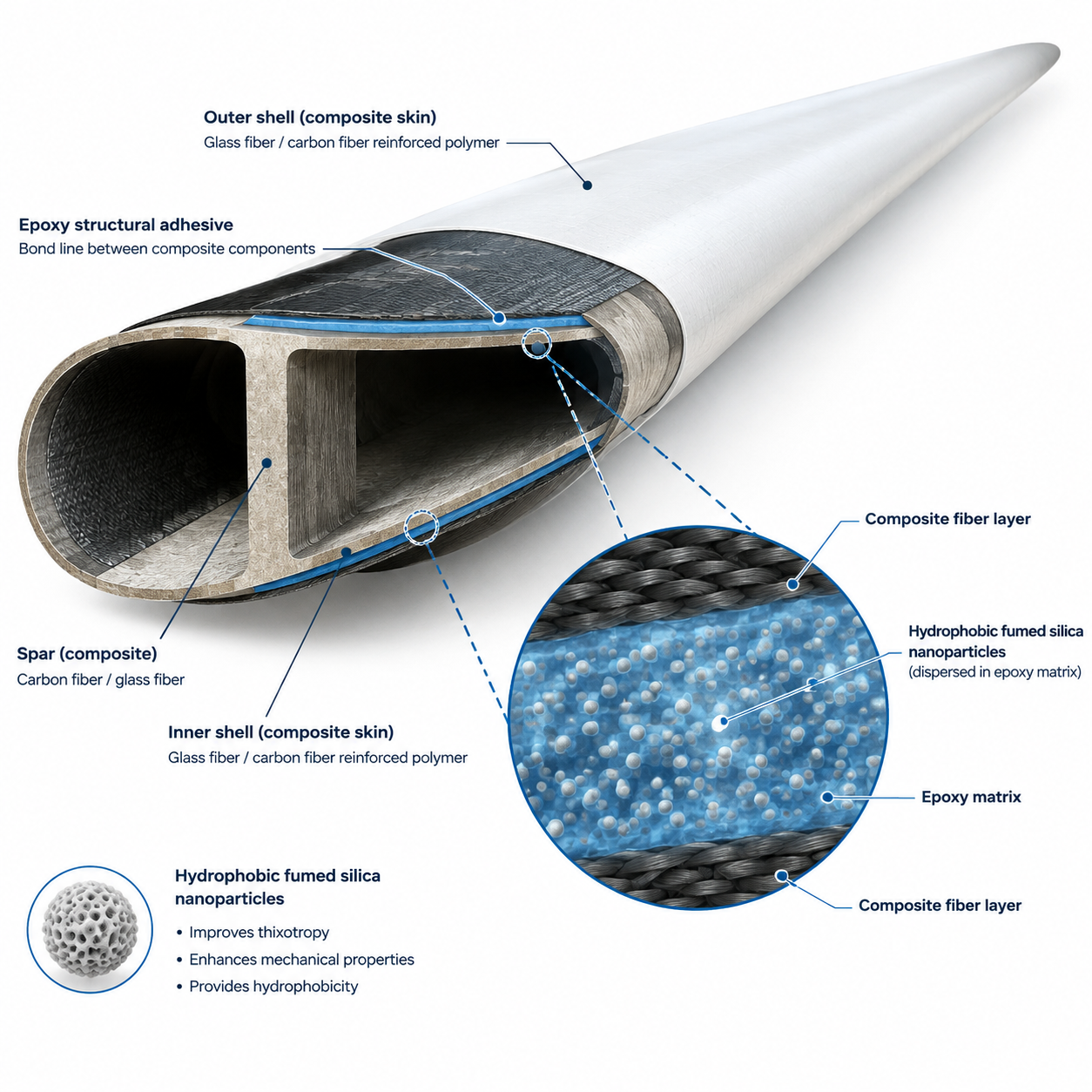
HIFULL® HB-139 is hydrophobic fumed silica which is produced by hydrophilic fumed silica with a specific surface area of 200m2/g after chemical post-treatment with PDMS / Polydimethylsiloxane, also known as silicone oil.
Figure 1 illustrates the changing trends of system viscosity and thixotropic index after adding different mass fractions of fumed silica HB-139 into the epoxy adhesive system, to evaluate the static viscosity of fumed silica under low shear rates and the flow characteristics under high shear rates.
The experiment set up six gradients: 0%, 2%, 5%, 6%, 7%, and 8% fumed silica additions. As shown in the chart, with the increase of fumed silica content, the viscosity of the epoxy adhesive shows a significant upward trend, and the thixotropic performance also strengthens accordingly, with both exhibiting a strong positive correlation.

Figure 1
From the perspective of viscosity change trends
When no fumed silica is added, the system viscosity is extremely low (close to 2892 mPa·s), with almost no structural strength, failing to meet the requirements of most construction scenarios.
As the addition increases to 2%, the viscosity reaches 9284 mPa·s; at 5%, the viscosity jumps to 31390 mPa·s, indicating that the network structure is gradually strengthening and tending toward perfection.
When the addition reaches 6%, the viscosity continues to rise to 46396 mPa·s; at 8%, the viscosity climbs sharply to 106791 mPa·s, an increase of about 37 times compared to the initial value, indicating that an excessive addition will cause the network structure to become too dense, the system tends towards a gel state, and fluidity drops significantly.
From the perspective of thixotropic changes
The thixotropic index gradually increases with the increase of fumed silica addition. When the addition increases from 0% to 8%, the thixotropic value increases from 1 to 8, which is 8 times that without fumed silica. The essence of this phenomenon lies in the microstructural evolution of fumed silica in the epoxy matrix.
Without the filler, the resin molecular chains move freely, and the viscosity is constant; after introducing nano-SiO₂, its surface active functional groups undergo physical adsorption or weak chemical bonding with the epoxy resin, forming a dynamic three-dimensional network structure.
Under static or low-shear conditions, this network remains stable, manifesting as high viscosity; while under high-shear rates (such as during stirring or coating), the network is destroyed, particles re-disperse, and viscosity drops, resulting in shear thinning. Once external force is removed, the network can be quickly rebuilt, restoring the high viscosity state, thus embodying typical thixotropic behavior.


The thickening and thixotropic effect of fumed silica in the epoxy system essentially depends on its dispersion state and network construction capability. At low addition, the particle dispersion is relatively sparse, the formed network is weak, and viscosity growth is limited; as the addition increases, the distance between particles decreases, hydrogen bonding strengthens, forming a spatial network that penetrates the system, and viscosity rises exponentially. The enhancement of thixotropy originates from the reversible disassembly and reconstruction capability of this network under external force. The higher the addition, the greater the network density, the faster the reconstruction speed, and the higher the thixotropic index.
However, when the addition exceeds a certain threshold (such as 8%), the network structure becomes too tight, which may lead to increased construction resistance, difficulty in coating, difficulty in bubble removal, affecting curing compactness, declining system stability, and increased costs. Therefore, in practical applications, it is necessary to seek a balance between viscosity and thixotropy according to specific construction methods (scraping, pouring, spraying, etc.) and anti-sagging requirements.
Further Reading:
Hello, Customers
My name is Van, I’m the business manager of HIFULL, I have been in Fumed Silica Industry for more than 10 years. Feel free to contact me. I’m happy to provide you the best service and products.