Fumed Silica vs. Bentonite in Polyurethane Adhesives: Viscosity and Thixotropic Performance
Comparison of Thickening and Thixotropic Performance of Fumed Silica HB-139 and Bentonite in Polyurethane Adhesives
Why Rheology Control Matters in PU Adhesive Formulations
Rheology control in the Part A component of a polyurethane (PU) adhesive directly affects storage stability, application behavior, and bead shape retention. Insufficient thickening can lead to sagging and filler settling, while inadequate thixotropy can cause an adhesive bead to slump after application to a vertical surface.
A comparison of fumed silica HB-139 and bentonite in a PU Part A system (Table 1) shows a substantial difference in their thickening and thixotropic performance. At 12 rpm, HB-139 achieves a viscosity of approximately 14,600 cP and a thixotropic index of about 3.2. Bentonite, by comparison, delivers approximately 6,200 cP and a thixotropic index of 1.6.
Under the tested conditions, HB-139 provides approximately 2.3 times the viscosity and twice the thixotropic index of bentonite. These results highlight the differences between the two rheology modifiers and their respective approaches to building structure within a polyurethane adhesive.


Table 1. Comparison of Fumed Silica HB-139 and Bentonite in a PU Part A System
How Fumed Silica Builds a Rheological Network in PU Adhesives
Fumed silica is a nanoscale amorphous material with a typical primary particle size of 7–40 nm, a high specific surface area, and a surface rich in silanol groups. In the polyol medium of a PU Part A formulation, hydrogen bonding between silanol groups on adjacent particles can create a three-dimensional network throughout the system.
This network is dynamic and reversible. Under shear, the network structure breaks down, reducing viscosity and allowing the adhesive to flow. When shear is removed, the network can reform, allowing viscosity to recover. This behavior contributes to the balance between application flow and resistance to sagging after application.
HB-139: Surface Modification and Thickening Efficiency
HB-139 is a hydrophobic fumed silica derived from a hydrophilic fumed silica with an initial specific surface area of 200 m²/g. Surface modification with polydimethylsiloxane (PDMS) reduces its specific surface area to 110 ± 30 m²/g and partially shields the surface hydroxyl groups, giving the material its hydrophobic character.
In the polyol medium of a PU Part A formulation, this surface modification influences the interaction between silica particles and the surrounding resin. The resulting dispersion behavior and network formation contribute to HB-139’s thickening and thixotropic performance.
The measured results show that HB-139 delivers substantially higher viscosity and a higher thixotropic index than bentonite at the tested dosage and under the specified conditions.
How Bentonite Builds Structure in PU Adhesives
Bentonite is a natural layered silicate that can be organically modified to improve its compatibility with organic formulation components. Its rheological behavior depends on interactions between the modified clay platelets and polar molecules in the surrounding medium. These interactions can produce a structure commonly described as a “card-house” network, which contributes to viscosity and thixotropy.
The effectiveness of this structure depends on the formulation environment. In solventborne and medium- to low-polarity systems, organically modified bentonite can provide useful rheological control. Its performance in a polyurethane Part A system, however, depends on the compatibility of the modified clay with the polyol medium and its ability to maintain a stable structure.

Compared with the hydrogen-bonding network formed by fumed silica, the bentonite structure relies on different particle interactions. Differences in network formation and breakdown can affect viscosity under shear and structural recovery after application.
In the tested PU Part A system, bentonite showed a lower viscosity and thixotropic index than HB-139. These results indicate that bentonite provided less rheological structure under the conditions evaluated.
What the Performance Difference Means for PU Adhesive Applications
The difference between a thixotropic index of 1.6 and 3.2 is relevant to the balance between flow during application and shape retention after application. A higher thixotropic index can indicate a greater difference between viscosity under low-shear and high-shear conditions, depending on the measurement method used.
For polyurethane adhesives, this balance affects several processing requirements:
- Sag resistance: Maintaining sufficient structure after application helps the adhesive bead retain its shape on vertical surfaces.
- Dispensing and pumping: Appropriate viscosity under shear supports material flow through dispensing equipment and application systems.
- Bead stability: Structural recovery after application helps limit bead deformation before the adhesive cures.
- Process consistency: Rheological control can influence the repeatability of adhesive application across production runs.
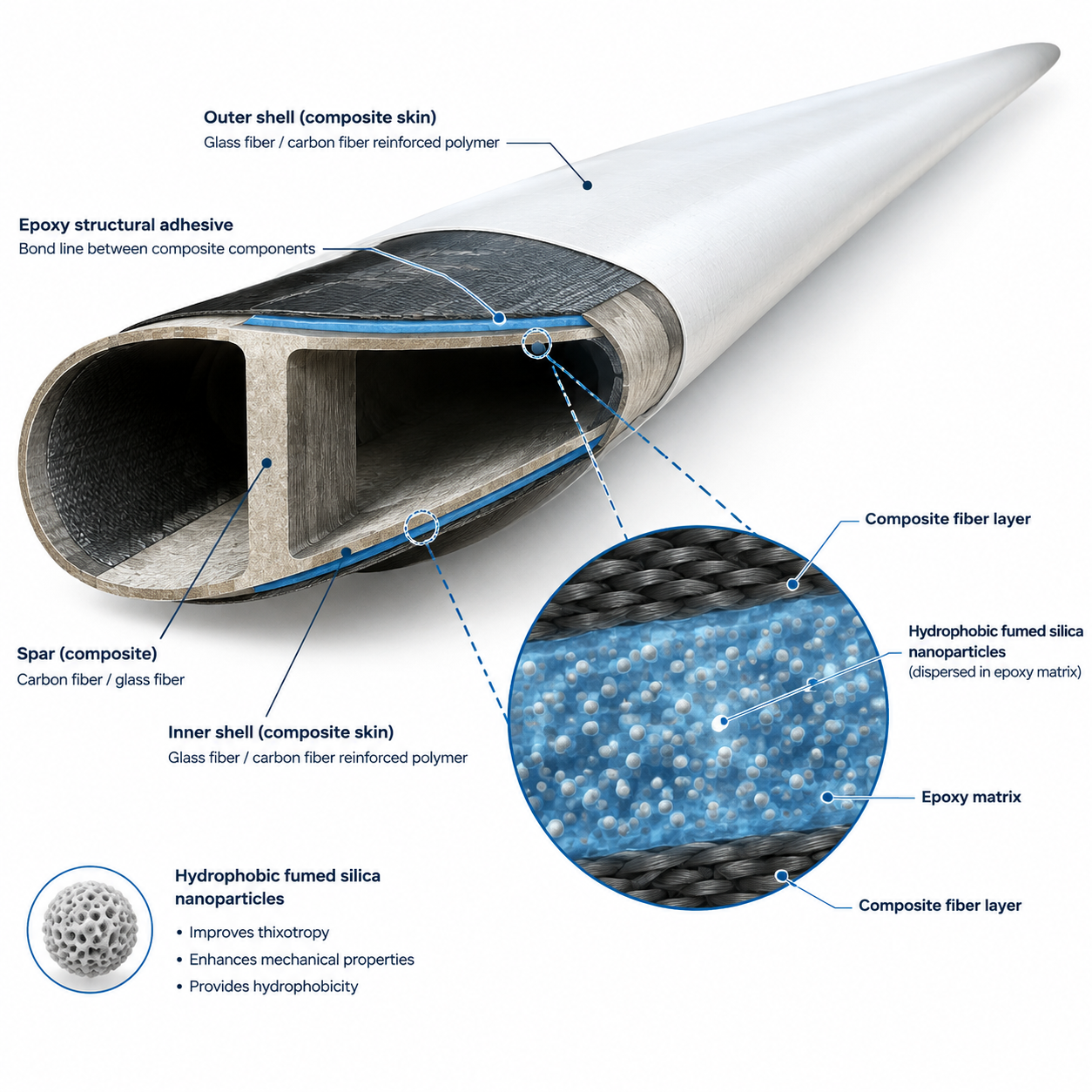
These requirements are relevant to applications such as power-battery encapsulation, wind-blade bonding, and electronics potting, where dispensing precision and bead stability can affect manufacturing quality.
The performance difference observed between HB-139 and bentonite provides a basis for evaluating their suitability for these applications. Actual performance will depend on the complete formulation, including the polyol system, filler loading, additive dosage, and application conditions.

Adhesives & Sealants
HIFULL® HB-139 for Polyurethane Adhesive Formulations
Hubei Huifu Nanomaterial Co., Ltd. has developed expertise in the production and surface modification of fumed nanoscale powders. HIFULL® has a stated fumed silica production capacity of 40,000 t/y and is recognized as a national-level key “Little Giant” enterprise, a designation for specialized, refined, distinctive, and innovative small and medium-sized enterprises in China.
Its product range includes hydrophilic fumed silica HL-200 and hydrophobic fumed silica HB-139, serving applications in coatings, adhesives, batteries, and composites. The company’s surface-modification and dispersion technologies support the development of fumed silica grades with different surface characteristics and performance profiles.


For polyurethane adhesive manufacturers, selecting a rheology modifier requires consideration of the resin system, filler content, storage stability, and application requirements. The comparison presented in Table 1 shows that HB-139 delivered higher viscosity and a higher thixotropic index than bentonite in the tested PU Part A system. For formulators developing high-solids or solvent-free polyurethane adhesives, these results provide a starting point for evaluating HB-139 as a rheology modifier. Further formulation-specific testing is required to determine the appropriate dosage and confirm its performance under actual production and application conditions.
Further Reading:
ABOUT HIFULL
Our main products are fumed silica, nano titanium dioxide, and nano aluminium oxide. We get 20+ years of expertise and 40,000 tons of annual capacity. We supply total of 23 grades of hydrophilic & hydrophobic fumed silica. We have registrations for EU-REACH, Turkey-REACH, K-REACH and UK-REACH. We are the leading setting body for ISO18473-3:2018, ISO23157:2021 and ISO18473-4:2022. Learn More About Hifull
Hello, Customers
My name is Van, I’m the business manager of HIFULL, I have been in Fumed Silica Industry for more than 10 years. Feel free to contact me. I’m happy to provide you the best service and products.