HIFULL® Hydrophobic Fumed Silica (DDS-Treated): Characteristics and Applications
Fumed silica, as an important functional filler, is produced by the hydrolysis of volatile chlorosilanes in a hydrogen-oxygen flame. It features nano-scale primary particles (typically 7-40nm), a high specific surface area (ranging from 30-450m²/g), and a highly developed agglomerated structure.
However, hydrophilic fumed silica is rich in surface silanol groups (-OH), possessing strong polarity and hygroscopicity. In highly polar organic systems or environments sensitive to moisture, it tends to absorb moisture and agglomerate, leading to decreased dispersibility and causing product stability issues. To address these limitations, hydrophobic fumed silica has emerged, with dimethyldichlorosilane (DDS) treatment technology becoming one of the important pathways to achieve surface hydrophobic modification.
HIFULL® hydrophobic fumed silica is prepared by surface modification of hydrophilic fumed silica. Common modifiers include dimethyldichlorosilane (DDS), hexamethyldisilazane (HMDS), and polydimethylsiloxane (PDMS), among others.
After surface modification, the hydroxyl groups on the silica surface are reacted or shielded, rendering the material hydrophobic.


Property
The working principle of DDS modification technology is based on a silanization reaction, where the silanol groups (-OH) on the surface of hydrophilic fumed silica chemically react with dimethyldichlorosilane. The surface polarity is effectively shielded, thereby significantly reducing surface energy and endowing the material with hydrophobicity and organic compatibility.
This modification not only reduces hygroscopicity but also improves dispersibility and rheological control capabilities in organic media. It is worth noting that hydrophobic treatment is not merely “masking” polarity, but rather achieving controllable adjustment of surface energy through molecular design, thereby adapting to systems of different polarities.
Characteristics and Differences of DDS-Modified Products
Through the DDS treatment process, various specifications of hydrophobic fumed silica products can be obtained, among which HB-151 and HB-152 produced by Hubei Huifu Nanomaterial Co., Ltd. are typical representatives.
HIFULL® hydrophobic fumed silica HB-151 is obtained by treating hydrophilic fumed silica with a specific surface area of 150m²/g via DDS; whereas treating hydrophilic fumed silica with a specific surface area of 200m²/g via DDS yields hydrophobic fumed silica HB-152.
These two product models exhibit significant differences in key parameters: the BET specific surface area of HB-152 is between 170±30m²/g, with a carbon content of 0.8-1.6%; whereas the BET specific surface area of HB-151 is between 120±30m²/g, with a carbon content of 0.6-1.2%.


It is precisely these differences in structural parameters that make HB-152 possess higher hydrophobicity, thickening and thixotropic properties, transparency, and reinforcing properties compared to HB-151.
In terms of physicochemical properties, hydrophobic fumed silica treated with DDS exhibits excellent stability. Taking HB-152 as an example, its loss on drying (dried at 105℃ for 2h) is ≤0.7, loss on ignition is ≤2.5%, silica content is ≥99.8%, and the pH value of the suspension (4%) is ≥3.9.
Rheological Control and Application Performance
Researchers at Hubei Huifu Nanomaterial Co., Ltd. have found that in terms of application performance, hydrophobic fumed silica treated with DDS mainly affects the rheological properties of coatings through the hydrogen bonding of surface silanol groups and the entanglement of treatment agent molecules.
Due to its hydrophobicity, it more easily interacts with non-polar organic molecules in coating systems, forming a loose network structure.
Taking UV coatings as an example, when the addition amount of hydrophobic fumed silica HB-151 increases from 0.5% to 2%, at low shear rates, the viscosity can increase from 400Pa·s to 2800Pa·s, a 600% increase; at high shear rates, the viscosity also increases from 420Pa·s to 1050Pa·s, a 150% increase—while the thixotropic value increases from 0.9 to 2.8, maintaining a growth of around 210%.
These unique rheological characteristics make hydrophobic fumed silica treated with DDS widely applicable in industries such as room temperature vulcanized (RTV) silicone rubber, electronic potting adhesives, adhesives and sealants, coatings, inks, and powder coatings.


Polarity Matching and Application Systems
According to the principle of polarity matching, materials with lower surface energy disperse more easily in low-polarity media, while medium-to-high polarity systems require fillers with moderate polarity to balance interaction forces.
Due to its extremely low surface energy, hydrophobic fumed silica treated with DDS is particularly suitable for low-polarity systems, such as MSPolymer (silane-modified polyether), STP-E, polyacrylates, and polysulfides. Their intermolecular forces are weak, necessitating the use of hydrophobic fumed silica with extremely low surface energy, such as HB-151 and HB-152. These products are typically subjected to deep alkylation modification and can bond well with the matrix through van der Waals forces, providing effective thickening, thixotropic, and reinforcing effects.
In contrast, medium-to-high polarity systems such as polyurethane, polyols, polyamide, epoxy resins, and vinyl resins require the selection of hydrophobic products that retain a small amount of polar sites on the surface. This avoids excessive agglomeration while allowing residual silanol groups or designed polar functional groups to participate in interfacial interactions and even promote crosslinking reactions.
Market Prospects and Future Development Directions
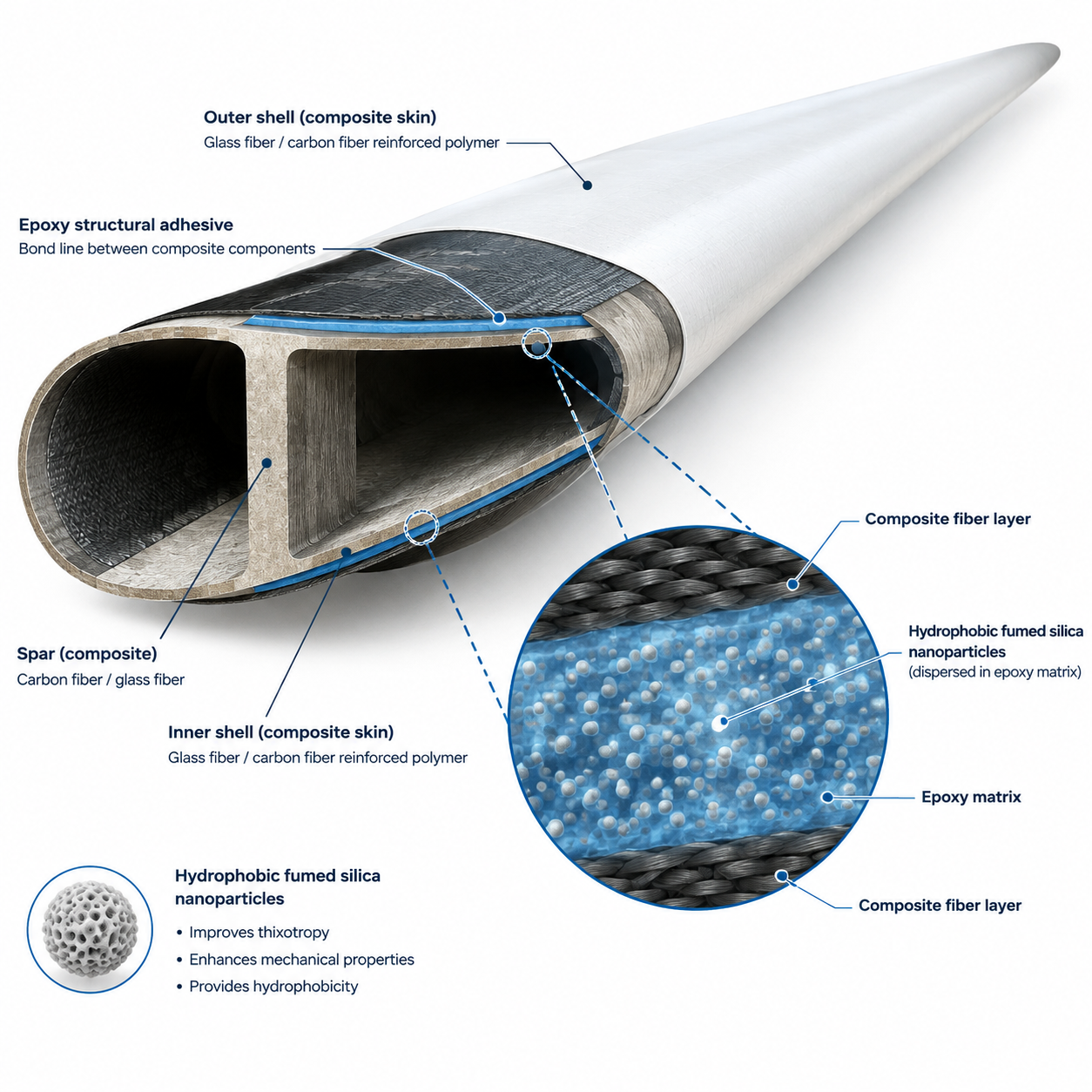
With the continuous increase in global demand for high-performance materials, the market prospects for hydrophobic fumed silica are extremely broad. Especially in fields with stringent requirements for adhesive performance, such as high-end electronic packaging, wind power blade bonding, and aerospace structural adhesives, the application of hydrophobic fumed silica treated with DDS will drive related fields towards more efficient and reliable development.
In the photovoltaic industry, hydrophobic fumed silica can significantly enhance the weather resistance, ozone resistance, and chemical corrosion resistance of photovoltaic adhesives, enabling them to adapt to complex and changing outdoor environments. As a key encapsulation material for solar photovoltaic modules, the performance of photovoltaic adhesive directly affects the modules’ reliability and service life.
Hello, Customers
My name is Van, I’m the business manager of HIFULL, I have been in Fumed Silica Industry for more than 10 years. Feel free to contact me. I’m happy to provide you the best service and products.